
Introduction
Not all noise problems come from an empty, echoey room. Some of the loudest and most persistent noise complaints in UAE buildings come from mechanical systems — HVAC ductwork, exhaust fans, chillers, and pump rooms. A sound attenuator is the product built specifically for this job. It fits into ductwork or air handling systems to reduce the noise that travels through them, without blocking the airflow the system needs to function. If your building, factory, or plant room has a noise complaint linked to mechanical equipment, this guide explains what a sound attenuator does, where it is used, and how to plan for one properly.

What Is a Sound Attenuator and How Does It Work
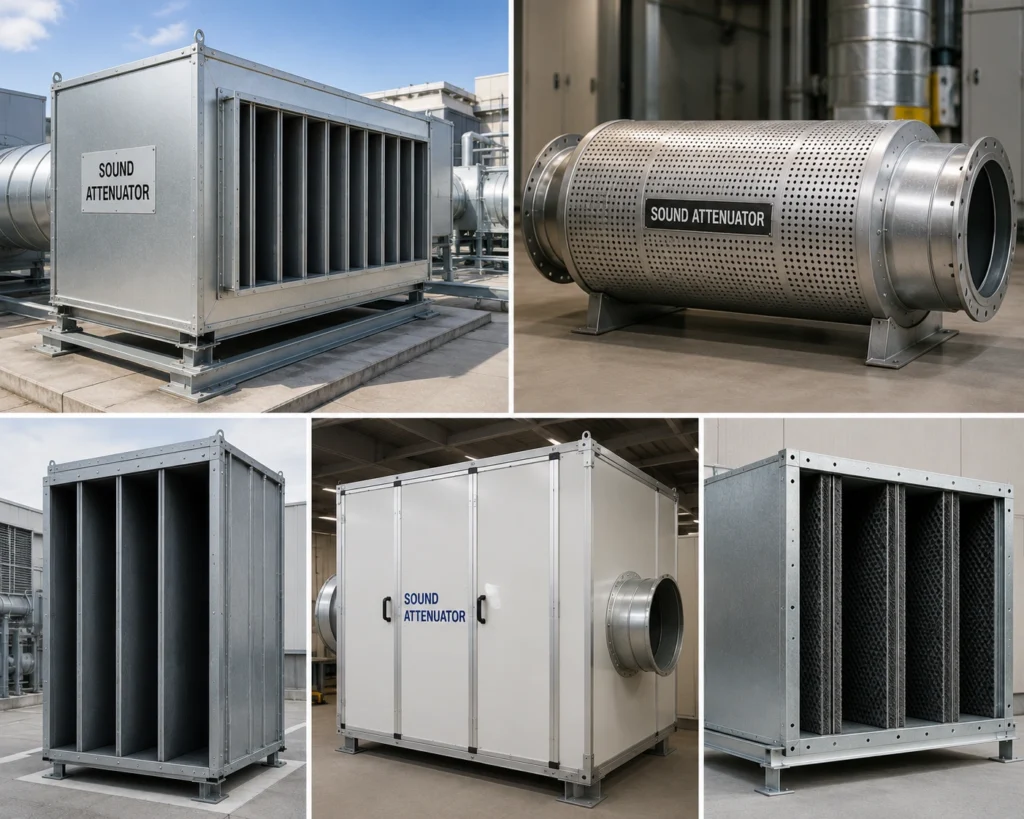
A sound attenuator is essentially a silencer for air-moving systems. Air passes through a series of internal baffles lined with sound-absorbing material, which forces sound waves to travel a longer, more absorptive path before reaching the other side. The airflow itself is barely affected because the baffles are designed around the required free area, but the noise level drops significantly. This makes a sound attenuator different from a simple acoustic enclosure — it is designed to let air through while still controlling sound, which is exactly what ventilation and exhaust systems need.
Common Applications in the UAE
Sound attenuators show up in more places than most people realize:
- Commercial HVAC systems – Reducing fan and duct noise in offices, malls, and hotels where mechanical rooms sit close to occupied spaces.
- Industrial plants and factories – Controlling noise from exhaust systems, compressors, and process equipment to meet workplace noise limits.
- Generator and plant rooms – Attenuating intake and exhaust noise so it does not disturb nearby residential or office areas.
- Data centers – Managing the noise from high-volume cooling systems that run continuously.
Given the UAE’s warm climate and heavy reliance on mechanical cooling, ventilation-related noise is one of the most common acoustic complaints in commercial and industrial buildings — which is exactly why sound attenuators are specified so often in HVAC design.
Sound Attenuators and Industrial Sound Enclosures Working Together
In many mechanical rooms, a sound attenuator alone is not the full solution. Loud equipment such as compressors or generators often also needs an industrial sound enclosure — a fully enclosed acoustic housing that surrounds the machine itself and blocks noise from escaping the room. Used together, an industrial sound enclosure controls noise at the source, while sound attenuators fitted to any ductwork or ventilation openings stop noise from leaking out through the airflow path. Treating only one of the two usually leaves a noticeable gap in performance, because sound will simply travel out through whichever path was left untreated.
Don’t Forget Vibration: The Role of Inertia Bases
Noise is not the only problem in a mechanical room. Rotating equipment like pumps and fans also generates vibration, which travels through the floor and structure into other parts of the building. Inertia bases are heavy concrete or steel platforms that equipment sits on, adding mass and stability that reduces vibration transmission before it becomes a structure-borne noise problem elsewhere in the building. Pairing sound attenuators for airborne noise with inertia bases for vibration control gives a mechanical room a complete acoustic treatment rather than addressing only half the issue.
Choosing the Right Sound Attenuator for Your Project
Selecting a sound attenuator requires more than picking a size that fits the duct. The required noise reduction, in decibels, needs to be calculated for the specific frequencies causing the problem. The pressure drops the attenuator adds must stay within what the fan or air handling unit can accommodate. And the physical length available in the ductwork run limits which attenuator models are practical to install. This is technical enough that it is worth involving a specialist early in the design process rather than trying to retrofit a solution after a noise complaint has already been raised.
Related blog – Sound Attenuators UAE: How They Control Noise in HVAC and Industrial Systems
Signs Your Facility May Need a Sound Attenuator
A few warning signs usually point to a ventilation or mechanical noise problem rather than a general acoustic issue. If noise levels rise noticeably whenever the HVAC system kicks in, the ductwork is likely carrying sound rather than just air. If a mechanical or plant room is audible from adjacent offices, corridors, or neighboring units even with the door closed, the noise is probably escaping through an untreated duct or vent opening rather than through the walls. And if a facility has already installed acoustic panels or insulation without resolving the complaint, that is often a sign the noise source is mechanical rather than a room acoustics problem, and a sound attenuator is the missing piece. Recognizing these patterns early makes it easier to fix the actual source instead of spending budget on the wrong solution.

Conclusion
Mechanical noise from HVAC and industrial systems is one of the most common — and most fixable — acoustic problems in UAE buildings. A properly specified sound attenuator, paired with industrial sound enclosures and inertia bases where needed, can bring a noisy plant room or mechanical system within acceptable limits without compromising the equipment’s performance. Perfect Acoustics designs and supplies sound attenuator solutions for commercial and industrial projects across the UAE. Reach out to discuss your mechanical noise challenge.