
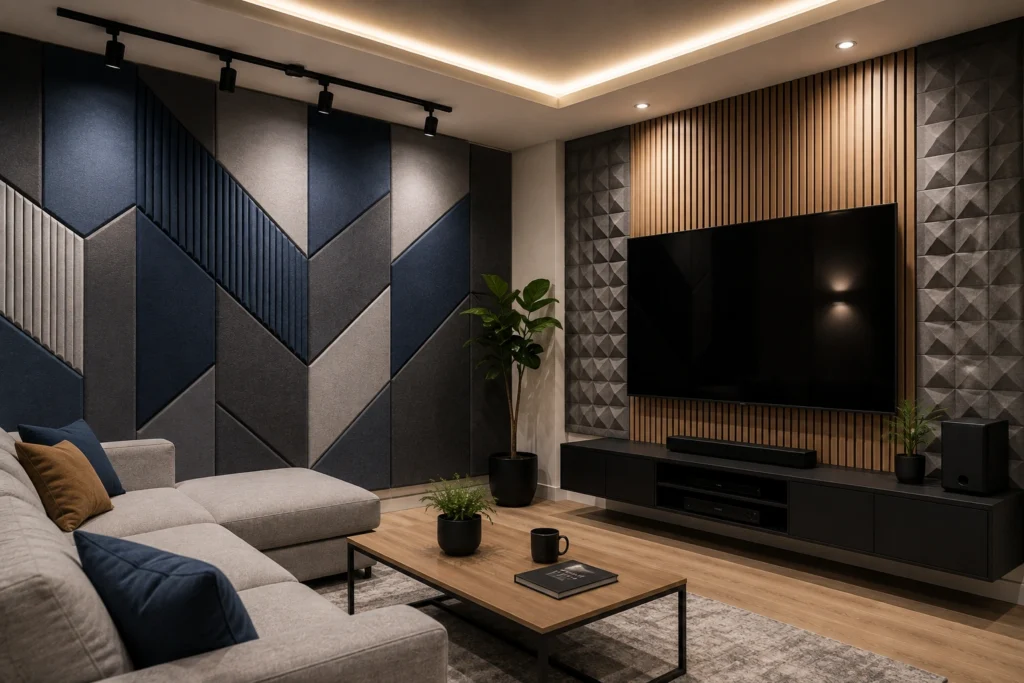
Introduction
September marks a busy season for UAE businesses. Offices reopen at full strength after the summer lull, new fit-outs get scheduled, and facility managers start planning budgets for the final quarter of the year. If acoustic comfort is on your checklist, acoustic wall panels are usually the first product people ask about — and for good reason. They are one of the fastest, least disruptive ways to fix an echoey meeting room, a noisy open-plan office, or a restaurant dining area that feels louder than it should. This guide walks you through the different types of acoustic wall panels available in the UAE, what actually drives their cost, and how to choose the right one so you do not end up overpaying for the wrong product.

Why Acoustic Wall Panels Are in Demand Right Now
Most commercial interiors in Dubai and across the UAE use glass, polished concrete, stone, and gypsum board — all hard, reflective surfaces. These materials look great, but they bounce sound around a room instead of absorbing it. The result is longer reverberation times, muffled speech in meetings, and background noise that builds up as a space fill with people. As teams return to full office capacity this month, many facility managers are noticing these problems for the first time simply because more people are back in the room. Acoustic wall panels solve this directly by absorbing sound energy at the wall instead of letting it bounce back into the space.
Types of Acoustic Wall Panels to Consider
Not every acoustic panel is built the same way, and the right choice depends on your space and budget.
- Fabric-wrapped panels – The most common choice for offices and boardrooms. They come in a wide range of colors and offer strong sound absorption without looking industrial.
- Perforated wood panels – A popular pick for reception areas and hospitality spaces where a warmer, natural look is important.
- PET felt panels – Made from recycled polyester fiber, these are lightweight, come in bold colors, and work well in schools and creative studios.
- Printed acoustic panels – Custom-printed with branding, artwork, or photography, useful when a business wants acoustic treatment that doubles as a design feature.
Choosing between them usually comes down to how the space is used, the look you want, and how much absorption the room actually needs.
What Drives the Cost of Acoustic Wall Panels
Pricing varies more than most people expect, and it is rarely just about the panel itself. Thickness and core density affect how much sound the panel absorbs, and thicker panels generally cost more. Fabric grade matters too — a standard acoustic fabric costs less than a fire-rated or stain-resistant option. Custom sizing and printed finishes add to the price compared to standard modular sizes. Finally, installation complexity plays a role: a straight wall run is quick to fit, while a curved wall, a high ceiling, or a pattern layout takes longer and adds labor cost. Getting an accurate quote means measuring the space first and describing exactly how it is used, not just asking for “panels.”
How to Choose the Right Acoustic Wall Panels for Your Space
Start with the problem you are actually trying to solve. A boardroom struggling with echo needs different coverage than an open-plan office trying to reduce overall noise buildup. As a rule of thumb, treating between 15 and 30 percent of the total wall and ceiling surface area is enough to noticeably improve most commercial rooms — going beyond that has diminishing returns unless the room is unusually reflective. Ask your supplier for the panel’s Noise Reduction Coefficient (NRC), which tells you how much sound it absorbs. A higher NRC means better absorption, but it should be matched to your specific noise problem rather than assumed to be “better is always better.”
Where Acoustic Wall Panels Deliver the Best Results
Certain areas benefit the most from acoustic wall panels: meeting and conference rooms where speech clarity matters, open-plan offices with high ceilings and hard flooring, restaurants and cafés where guest conversations compete with kitchen and music noise, and reception areas where echo makes a space feel unwelcoming. If you are also comparing suppliers, keep in mind that panels supplied without performance data are hard to evaluate properly — a reliable acoustic panel Dubai provider should be able to share NRC ratings and recommend coverage based on your room, not just its size.

Conclusion
Acoustic wall panels remain one of the most practical upgrades a UAE business can make this season, especially as offices fill back up after summer. The key is matching the panel type, thickness, and coverage to the actual problem in your space rather than picking based on appearance alone. Perfect Acoustics can help you assess your space and recommend acoustic wall panels that fit both your acoustic goals and your budget. Get in touch to plan your next fit-out with acoustic comfort built in from the start.