
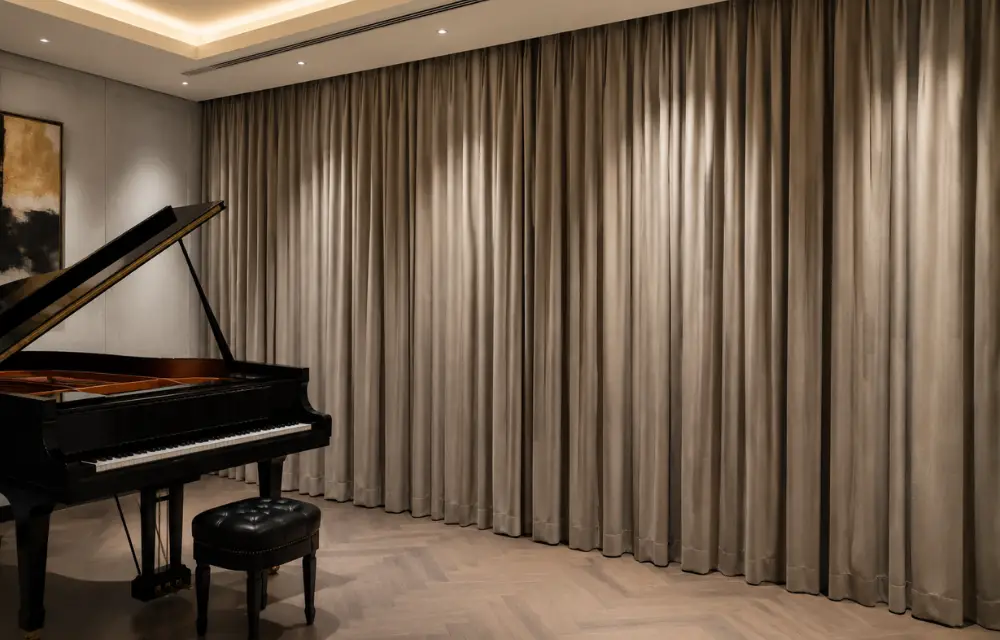
Introduction
When people think about controlling sound in a room, they often jump straight to foam panels or structural modifications. But one of the most practical, flexible, and visually appealing solutions is often overlooked — the acoustic curtain. An acoustic curtain is a specially manufactured heavy textile panel used to absorb sound, reduce echo, and in some cases provide a degree of sound isolation between spaces. Unlike fixed wall panels, curtains can be drawn back when not needed, making them ideal for multi-purpose rooms, event spaces, studios, and commercial interiors. However, not all curtains marketed as acoustic actually perform to a useful standard. This guide explains what makes a high-quality acoustic curtain and what specific features you should look for when making a purchase.

What Is an Acoustic Curtain?
An acoustic curtain is a thick, dense textile panel specifically manufactured to absorb and dampen sound. It typically contains multiple internal layers — including a sound-absorbing core and a heavy outer fabric — that work together to reduce reflected sound within a room. Some higher-specification acoustic curtains incorporate a dense mass-loaded barrier layer that adds a degree of sound transmission reduction, meaning they partially reduce sound passage through the curtain in addition to absorbing room reflections.
They are available in a wide range of sizes, colours, and styles, making them compatible with both industrial environments and refined interior design schemes. This combination of acoustic performance and visual flexibility is one of the key reasons acoustic curtains are increasingly popular across commercial, hospitality, and residential markets.
Multi-Layer Construction Is Essential
The most important quality indicator for any acoustic curtain is how it is built. High-quality acoustic curtains are manufactured with multiple distinct layers, each serving a specific purpose. The outer fabric provides visual appeal and contributes some absorption. The middle core layer — typically dense acoustic foam, mineral wool fill, or a composite absorptive material — does the main work of absorbing sound energy. Premium models include an additional mass-loaded vinyl layer that enhances sound blocking capability beyond basic absorption.
A curtain made from a single heavy fabric, regardless of how thick it feels, performs very poorly acoustically compared to a properly engineered multi-layer product. Always check the construction specification and ask the supplier to confirm what each layer does.
Mass and Weight Determine Performance
Mass is a fundamental acoustic principle — heavier and denser materials are better at both absorbing and blocking sound. A high-quality acoustic curtain should have significant weight per square metre. Premium products often weigh between 1.5 kg and 3 kg per square metre or more. This density is what gives the curtain genuine acoustic capability rather than the minimal effect of standard decorator curtains, even heavy ones.
Lightweight curtains promoted as acoustic products often provide very little measurable benefit in real-world applications. Weight and density are not the only factors, but they are among the most reliable quick indicators of acoustic quality.
Verified NRC Rating
The Noise Reduction Coefficient is a standardized measure of how much sound a material absorbs across a range of frequencies. A perfectly reflective surface has an NRC of 0, and a perfectly absorptive material scores 1.0. High-quality acoustic curtains typically achieve NRC ratings between 0.5 and 0.9, depending on construction and thickness. When comparing products, always request the independently tested NRC data rather than relying on manufacturer claims alone. Reliable suppliers provide test results across multiple frequency bands.
Broad Frequency Range Performance
Sound spans a wide range of frequencies — from deep bass to high treble. A good acoustic curtain should absorb meaningfully across the whole range rather than only at specific frequencies. Thicker and heavier curtains handle lower frequencies better, which matters greatly in music spaces, cinemas, and industrial areas with machinery noise. Look for suppliers who can provide frequency-specific absorption data rather than just a single averaged figure.
Proper Suspension and Full Coverage
How the curtain is hung matters as much as the curtain itself. Acoustic curtains should cover the full height of the wall being treated — from as close to the ceiling as possible to as close to the floor as possible. Gaps at the top, bottom, or sides significantly reduce acoustic performance because sound travels freely through untreated areas. Heavy-duty tracks, ceiling-mounted rails, or eyelets with appropriate support ensure the curtain hangs fully and evenly without bunching.
Suggested Read – Why Acoustic Curtains Are the Best Alternative to Soundproof Walls?
Fire Safety Certification
In commercial, hospitality, healthcare, and educational environments, fire safety compliance is not optional. High-quality acoustic curtains must carry recognized fire safety certifications. In the UAE, compliance with local civil defence fire safety standards are mandatory for any installed textile product in public or commercial spaces. Never compromise on fire certification regardless of how impressive the acoustic specifications appear.
Durability and Maintenance
Acoustic curtains in commercial settings need to withstand regular use, cleaning, and exposure to sunlight and dust without degrading in appearance or acoustic performance. Quality curtains use fade-resistant, hard-wearing outer fabrics and internal layers that retain their structure and density over time. Many are designed for dry-cleaning or surface cleaning without damaging the acoustic core layers.

Conclusion
A high-quality acoustic curtain brings together smart multi-layer construction, meaningful mass, verified acoustic performance data, proper fire safety certification, and durable materials into a single flexible acoustic solution. Whether you are treating a recording studio, a hotel ballroom, a conference room, or a home cinema in the UAE, the right acoustic curtain begins with understanding these key features and choosing a supplier who can verify performance rather than simply making promotional claims.