
Introduction
In many commercial and institutional buildings, the HVAC system is one of the most significant sources of unwanted noise. Fans, air handling units, and air flowing through ductwork generate broadband sound that travels efficiently through sheet metal ductwork and emerges into occupied spaces as a constant background drone or hiss. The primary engineering solution to this problem is the sound attenuator — a device installed within the ductwork to absorb sound energy before it reaches the rooms where people work, rest, or learn. Understanding the different types of sound attenuator available and how each one works is important knowledge for anyone involved in building design, HVAC specification, or facility management.

What Is a Sound Attenuator?
A sound attenuator — also called a duct silencer — is a lined duct section or acoustic insert designed to absorb sound energy as air passes through it. Unlike acoustic foam panels that treat the sound within a room after it has already arrived, sound attenuators work within the mechanical system — the ductwork — to intercept noise before it reaches occupied spaces. They are a standard component in commercial HVAC design for offices, hotels, hospitals, schools, theatres, and any building where low background noise levels are required.
The effectiveness of a sound attenuator is measured by its insertion loss — the reduction in sound level it achieves at each frequency band when installed, compared to the same length of unlined duct. Insertion loss is expressed in decibels across the standard octave bands from 63 Hz to 4000 Hz.
Type 1: Rectangular Splitter Attenuators
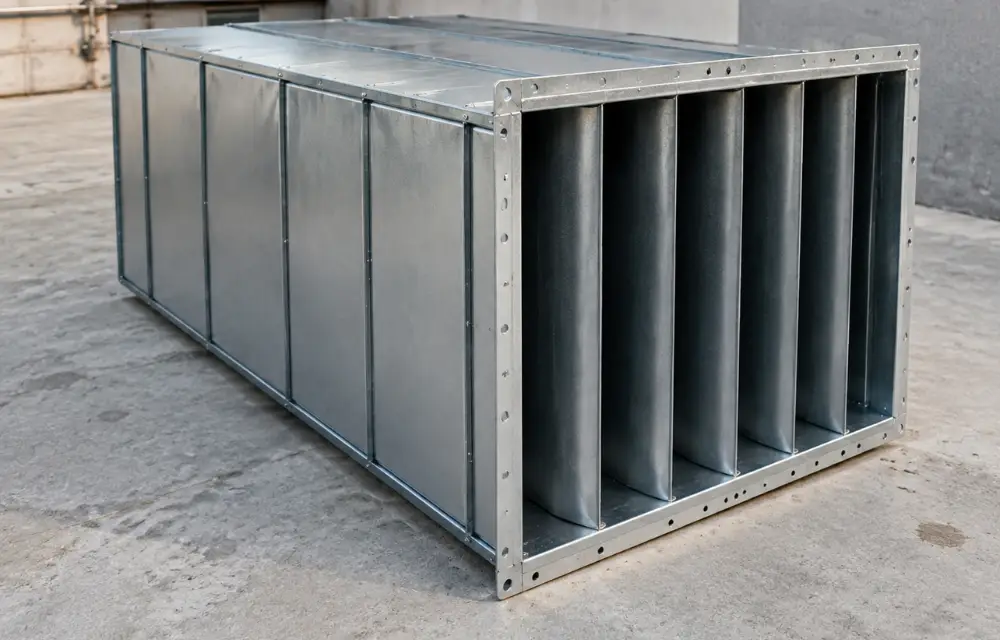
The most common type used in commercial buildings is the rectangular splitter attenuator. These consist of a rectangular outer casing containing a series of parallel acoustic pods — known as splitters — lined with absorptive fill material such as mineral wool. Air flows through the channels between the splitters, and the extended contact between the moving air and the absorptive surfaces progressively reduces the sound energy in the airstream.
Splitter attenuators are available in various lengths from around 600mm to 2400mm or more, with different splitter spacing configurations that control the balance between acoustic insertion loss and resistance to airflow. Longer attenuators with closely spaced splitters achieve the highest insertion loss but also create the most resistance to airflow, which affects fan energy consumption. Shorter units with wider splitter spacing have lower pressure drop but less acoustic performance. Selecting the right balance is a key design decision.
These units are the standard acoustic solution for supply and return air ductwork in commercial buildings, mechanical service corridors, and plant rooms.
Type 2: Circular Attenuators
Where circular ductwork is used — common in smaller HVAC systems, branch ducts, and residential applications — circular attenuators provide the equivalent acoustic function to rectangular splitter units. They typically feature an annular lining of absorptive material around the inside of a circular casing, sometimes with an additional central acoustic pod that increases the absorptive surface area within the unit.
Circular attenuators are appropriate for medium and smaller diameter ducts where rectangular units would not be practical to install. They are often used in smaller commercial buildings, retail environments, and domestic HVAC systems.
Type 3: Elbow and Bend Attenuators
When ductwork changes direction, the elbow or bend section itself can be acoustically treated. Elbow attenuators combine a directional change in the ductwork with acoustic absorption, making efficient use of available space in locations where a separate straight attenuator section cannot be accommodated. The lined inner surfaces of the elbow absorb sound as the air changes direction.
These are particularly useful in tight plant rooms and mechanical floor spaces where space constraints prevent the installation of standard straight attenuator sections.
Type 4: Fan Intake and Discharge Attenuators
Large fans and air handling units generate their most intense noise at the inlet and outlet connections. Fan attenuators are specifically engineered to be installed directly at these connections, intercepting noise at the primary source before it has the opportunity to propagate into the duct network. These units are built to a heavier duty specification than standard duct attenuators to withstand the higher velocities, turbulence, and pressure variations at the fan connection.
In large commercial and industrial HVAC systems, fan attenuators are an essential element of the overall noise control strategy, often providing the single largest acoustic improvement of any individual component in the system.
Type 5: Reactive Attenuators
While most attenuators are absorptive — absorbing sound energy in the lining material — reactive attenuators work on a fundamentally different principle. They use expansion chambers or resonant cavities that are tuned to specific frequencies to reflect or cancel sound energy back toward its source. Reactive attenuators are particularly effective at low frequencies that absorptive linings struggle to address.
They are most commonly used in low-velocity, high-volume ventilation applications — large industrial air handling systems, tunnel ventilation, and similar installations where dominant noise frequencies are concentrated in the low end of the acoustic spectrum.
Also Read – Why Sound Attenuators Are Essential in Noise Control?
Choosing the Right Type
Selecting the correct sound attenuator requires a proper acoustic calculation. The designer needs to know the sound power levels generated by the fan at each octave band, the target background noise levels in the occupied spaces, the available pressure drop budget, and the physical space constraints along the ductwork route. Getting this specification right prevents both under-performance — leaving the noise problem partially unsolved — and over-specification, which wastes fan energy unnecessarily.

Conclusion
Sound attenuators are essential tools for controlling HVAC noise in commercial and institutional buildings. By understanding the different types available — rectangular splitter, circular, elbow, fan, and reactive — engineers and building professionals can specify the right solution for each application. Choosing the correct sound attenuator type ensures occupied spaces achieve the low, comfortable background noise levels needed for productivity, wellbeing, and technical performance. Consulting with an acoustic specialist during the design phase is always the most effective way to get this specification right from the start.