
Introduction
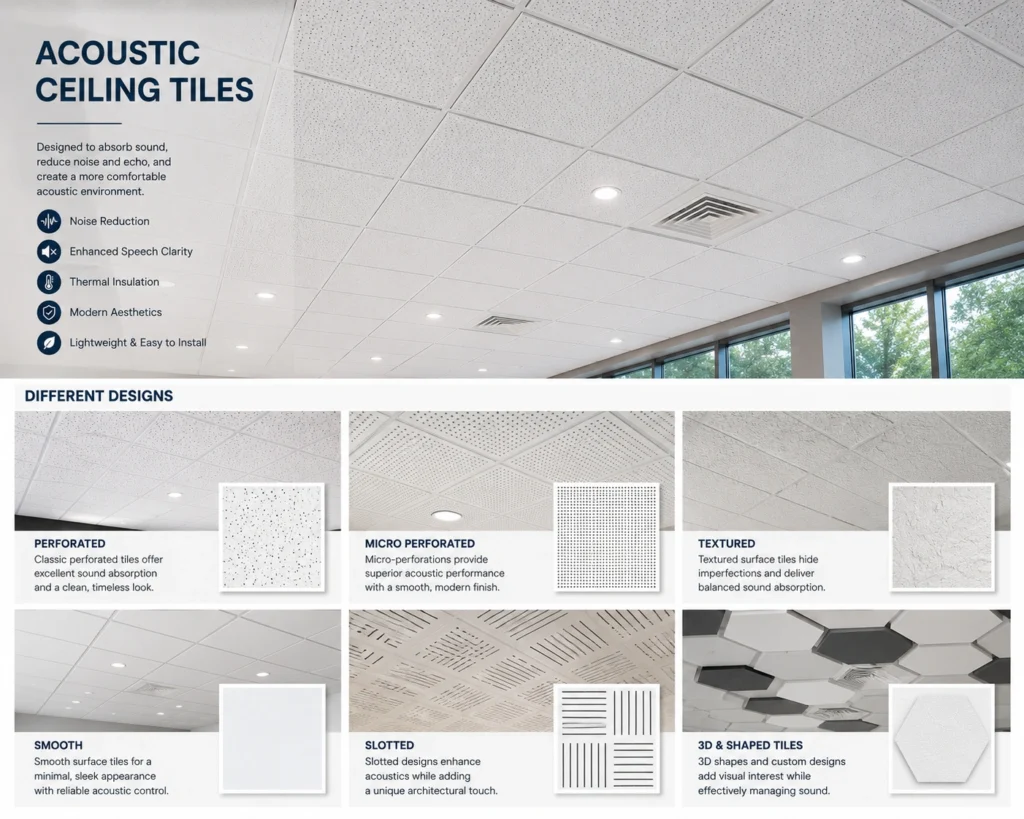
Walls are not the only surface worth treating when a room sounds too loud or too echoey. In many offices, schools, and commercial spaces, the ceiling is actually the biggest contributor to the problem — it is a large, flat, hard surface directly above every conversation in the room. Acoustic ceiling tiles address this by replacing or covering a standard ceiling with a sound-absorbing alternative, and as UAE offices fill back up this September after the summer break, many facility teams are finding that ceiling noise is the missing piece in their acoustic upgrade plan. This guide covers what acoustic ceiling tiles do, where they work best, and how to combine them with other treatments for a complete result.

Why the Ceiling Matters More Than People Expect
In a typical office with a suspended ceiling, standard tiles offer very little sound absorption — most reflect sound straight back down into the room. This is one reason open-plan offices with high, hard ceilings feel noisy even after walls have been treated with acoustic panels. Acoustic ceiling tiles are designed specifically to absorb this reflected sound instead of bouncing it back, which is especially effective in rooms where wall space is limited by windows, glass partitions, or furniture, leaving the ceiling as the largest available surface for treatment.
Types of Acoustic Ceiling Tiles
Several ceiling tile formats are commonly used across UAE commercial fit-outs:
- Mineral fiber acoustic tiles – A cost-effective standard option widely used in offices and retail spaces, fitting into standard suspended ceiling grids.
- Fabric-faced acoustic tiles – Offering a cleaner, more finished look for boardrooms and reception areas.
- Acoustic ceiling clouds and baffles – Suspended panels used where a full ceiling replacement is not practical, or where an exposed-ceiling design aesthetic needs to be preserved.
- Perforated metal acoustic tiles – Durable options for spaces needing a more industrial or technical look, such as labs or technical facilities.
Combining Ceiling Tiles with Floor Treatment
Ceiling and floor sit on opposite ends of a room, but they work together in how a space actually sounds. A ceiling treated with acoustic ceiling tiles reduces overhead reflections, but footfall and rolling chair noise on a hard floor can still create a distracting amount of impact sound, particularly in open-plan offices. Adding a noise absorbing carpet or carpet tile to high-traffic areas addresses this second half of the problem, cutting down on both the impact noise itself and some of the airborne noise bouncing off the floor. Offices that treat only the ceiling often find the room sounds better but still feels noisy underfoot — pairing the two surfaces gets a more complete result.
Where Acoustic Ceiling Tiles Make the Biggest Difference
Certain spaces see the most noticeable improvement from ceiling treatment: open-plan offices with exposed or high ceilings, classrooms and lecture halls where speech clarity affects learning, call centers and customer service floors where multiple conversations happen simultaneously, and retail spaces with hard flooring and glass storefronts that amplify ambient noise. In each of these, the ceiling is doing more acoustic damage than most people assume until it is treated.
Installation Considerations
Acoustic ceiling tiles generally install into existing suspended ceiling grids, which makes them one of the less disruptive acoustic upgrades available — most installations do not require major construction work. That said, coverage still needs to be planned properly. Treating only a small section of the ceiling rarely delivers a noticeable improvement; the tiles need to cover enough of the reflective surface to meaningfully change how sound behaves in the room. A short site assessment before ordering is the easiest way to avoid under-treating the space.
Related blog – Why Acoustic Ceiling Tiles Are Essential for Modern Buildings?
Maintenance and Long-Term Performance
Acoustic ceiling tiles hold up well over time, but a few habits help protect their performance. Tiles should be kept dry, since water damage from leaks or condensation can affect both their appearance and their absorption properties. Dust and debris should be cleared periodically, particularly in retail or industrial settings, since a heavily soiled surface absorbs less sound than a clean one. And if a ceiling is ever modified for new lighting, sprinklers, or cabling, it is worth checking that the acoustic tiles removed for the work are replaced correctly rather than swapped for standard tiles, which quietly undoes part of the original treatment without anyone noticing until the noise complaints return.

Conclusion
Acoustic ceiling tiles are one of the most practical upgrades for offices, schools, and commercial spaces dealing with echo and noise buildup, especially now that teams are back at full capacity after the summer. Pairing ceiling treatment with a noise absorbing carpet in high-traffic areas gives a more complete acoustic result than treating either surface alone. Perfect Acoustics supplies and installs acoustic ceiling tiles for commercial projects across the UAE. Contact us to plan your ceiling treatment.